A minute to learn. Considerably longer to win.
A few holes dug in the sand, a few shells, and the game begins. Nothing is captured, nothing is collected: you move, you line up, you block.
Taking your move back.Six lines of rules.You already know them
- The board has sixteen holes, all empty at the start.
- Players take turns placing their four shells in free holes.
- A win only counts once all eight shells are down.
- After that, you move one shell one square, horizontally or vertically.
- A shell that has just moved can't go back where it came from on your next turn.
- Line up your four shells and you win.
Rule five is the no-return rule. It stops two cautious players sliding the same piece between two squares until the end of time, and forces the position to keep moving.
Why Swash
The swash is the sheet of water that runs up the beach after a wave breaks. The backwash is its retreat. That back and forth erases and redraws the marks in the sand without ever stopping.
Which is exactly what the game does: pieces advance, retreat, work around each other, and the advantage keeps sliding from one end of the board to the other.
- A game lasts3 to 8 minutes
- Opponent levels4
- Ways to playSolo, local, online
- Ads or purchasesNone
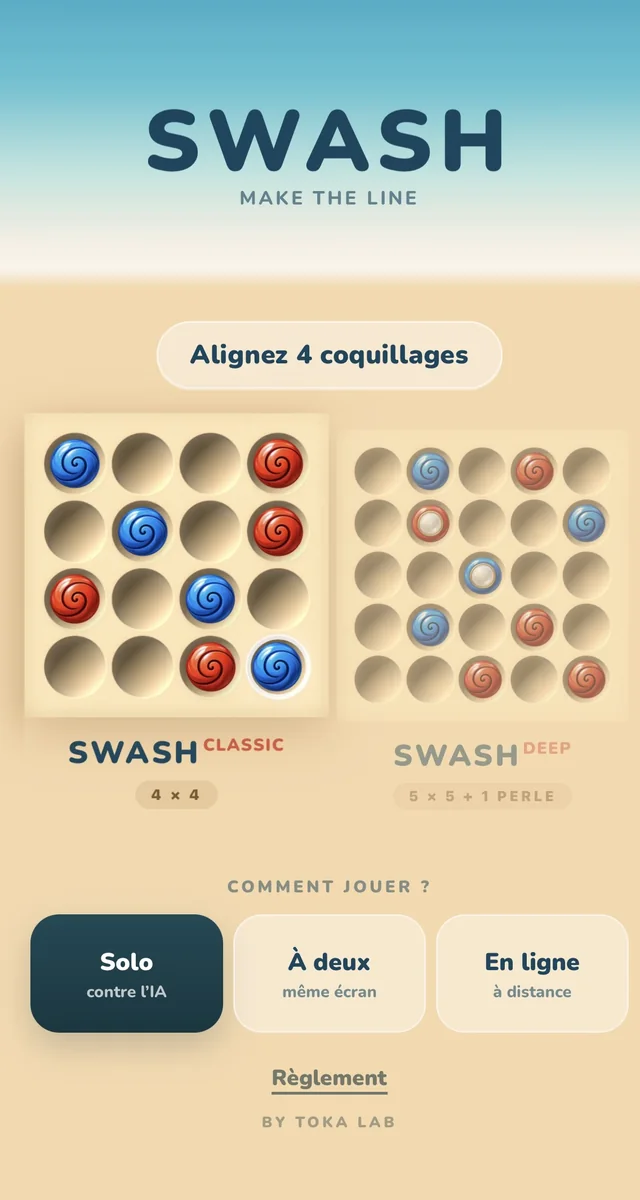
Swash, and Swash Deep
The second doesn't replace the first. We keep both, deliberately.
Swash — 4 × 4
Four shells each, one square per move, a line of four to complete. The purest form of the idea: short, sharp, nothing to memorise.
Swash Deep — 5 × 5
Five pieces each, one of them a Pearl that also moves diagonally. Line up four out of five. And crucially: each player places the opponent's Pearl.
Cross-placement is the find of the 5 × 5. You don't choose where your key piece starts — you decide where your opponent's does. Both players open the game with a piece they didn't position.
What people ask
Can you take an opponent's piece?
No. No piece ever leaves the board. There's no capture, no material advantage, no power to accumulate. The only lever is movement.
What is the no-return rule for?
Without it, two cautious players can slide the same piece between two squares indefinitely and the game stops moving. The rule makes that deadlock impossible.
Does the first player have an edge?
On the 4 × 4, no, and it's proven: with perfect play on both sides the game is drawn from any opening placement. On the 5 × 5, cross-placement was introduced precisely to correct a measured first-player advantage.
Do I need a connection?
Only to play someone online. Everything else works offline.
Does Swash Deep replace Swash?
No. Two distinct games, maintained side by side. Some players prefer the sharpness of the small board.
Easiest thing is to try one
The games run in your browser, free. The apps are in the catalogue.