A field notebook the whole team can read.
What you just saw goes down in thirty seconds, lands on the map, and is already visible to everyone else — wildlife, trees, anything that makes up the ground you look after.
The sign-in form.The map, right away.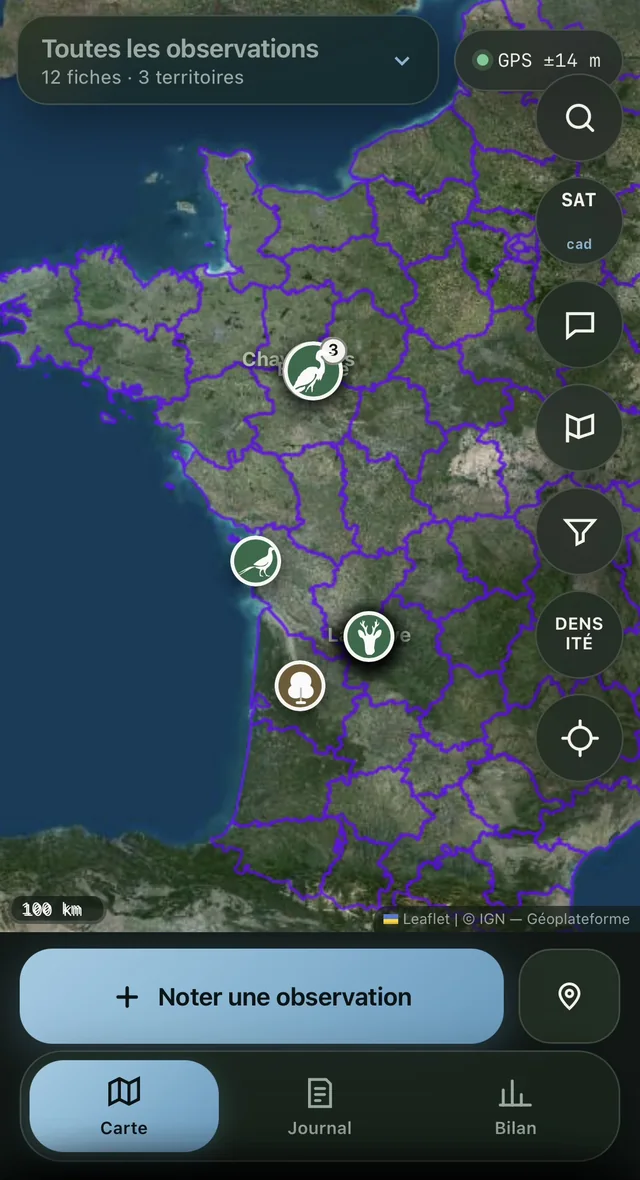
A notebook in your pocket works well
A date, a rough location, a number. The field notebook has been around forever, and it has one flaw: it stays in the pocket of whoever filled it in.
The apps meant to replace it fall into two traps. Naturalist platforms are rigorous but slow to fill in, built for a desktop, with no notion of a team. Hunting apps keep one species, one count, one sex — and lose everything else.
None of them lets a handful of people record, in thirty seconds and out in the field, what they have just seen, with the precision the vocabulary allows, and know it has been shared.
- Animal species referenced119
- Tree species referenced113
- Age and sex class sets15
- Photo identificationTwo engines
- MappingIGN — satellite, plan, cadastre
- Account requiredNone
- MarketFrance
Two engines, because one wasn't enough
A general-purpose model confuses oak bark with sweet chestnut. So plants don't go to the same place as animals. Trees are sent to Pl@ntNet, trained on millions of botanical observations — two photos at once, one declared as the habit, one as the leaf, and the engine crosses them.
Animals go to a general model, which handles them well. Splitting the two doubled the plumbing and roughly halved the error on bark.
It proposes, it never fills in
Identification sits exactly where it earns its place — the moment of doubt — and nowhere else. You accept, you correct, or you ignore. It never completes the form for you, never guesses a count, never overwrites what you typed. The entry stays yours.
No key is published in the site file: it is supplied by you and kept on your device, or held by a server-side relay. No account is attached to the request, and nothing about you travels with the image.
The exact age. A bracket instead.
A tree's age is deduced from its circumference at 1.30 m, divided by the annual growth of its species. Divide, and you get a number. It would be wrong.
Two things weigh heavily. Setting: a tree standing alone grows nearly twice as fast as one in a dense stand. And large timber slows down, which a plain division ignores.
So Affût gives a bracket. Never a figure. It looks less impressive and it is the only honest answer.
- Measured at1.30 m from the ground
- Habit recordedSingle stem, pollard, coppice, grafted
- Setting recordedDense stand to open ground
- ResultA bracket, never a figure
A wild boar doesn't exist
It's a sow with three young. That precision isn't decoration: it's the only way to produce data that says anything real about a population — and the same goes for a stand of trees.
- 01Sighting first
You record a sighting without setting anything up. Territory, drives and stands come later, as layers on top.
- 02Map before form
The app opens on GPS and the map. Entry follows the gesture of the field, not the order of a database.
- 03One hand, gloves, glare
Large targets, high contrast, patchy signal assumed. The field sets the ergonomics, not the desk.
Four things, done properly
Observe
119 wildlife species with their exact names, and an age and sex breakdown rather than a headcount. Trees and standing timber are recorded the same way — species, size, condition, position. The weather attaches itself to every entry, and photo identification steps in when doubt remains.
Map
IGN layers in satellite, plan or cadastre. Territory outlines with calculated area. Markers, filters and sighting history.
Manage the ground
Drive plans with numbered stands you reposition by finger. A past drive picked up in one gesture. Member presence and arrival. Team messaging. The territory is what everything else hangs on.
Share
Join a team with a code, everything syncs live. Several teams per person. And a team can exist with no territory at all — a family outing, for instance.
Easiest thing is to try one
The games run in your browser, free. The apps are in the catalogue.